
When Your Hot Water Stops Working, Here’s What to Do
AO Smith water heater repair is something thousands of homeowners face every year — often at the worst possible moment.
Quick answer: How to get your AO Smith water heater repaired
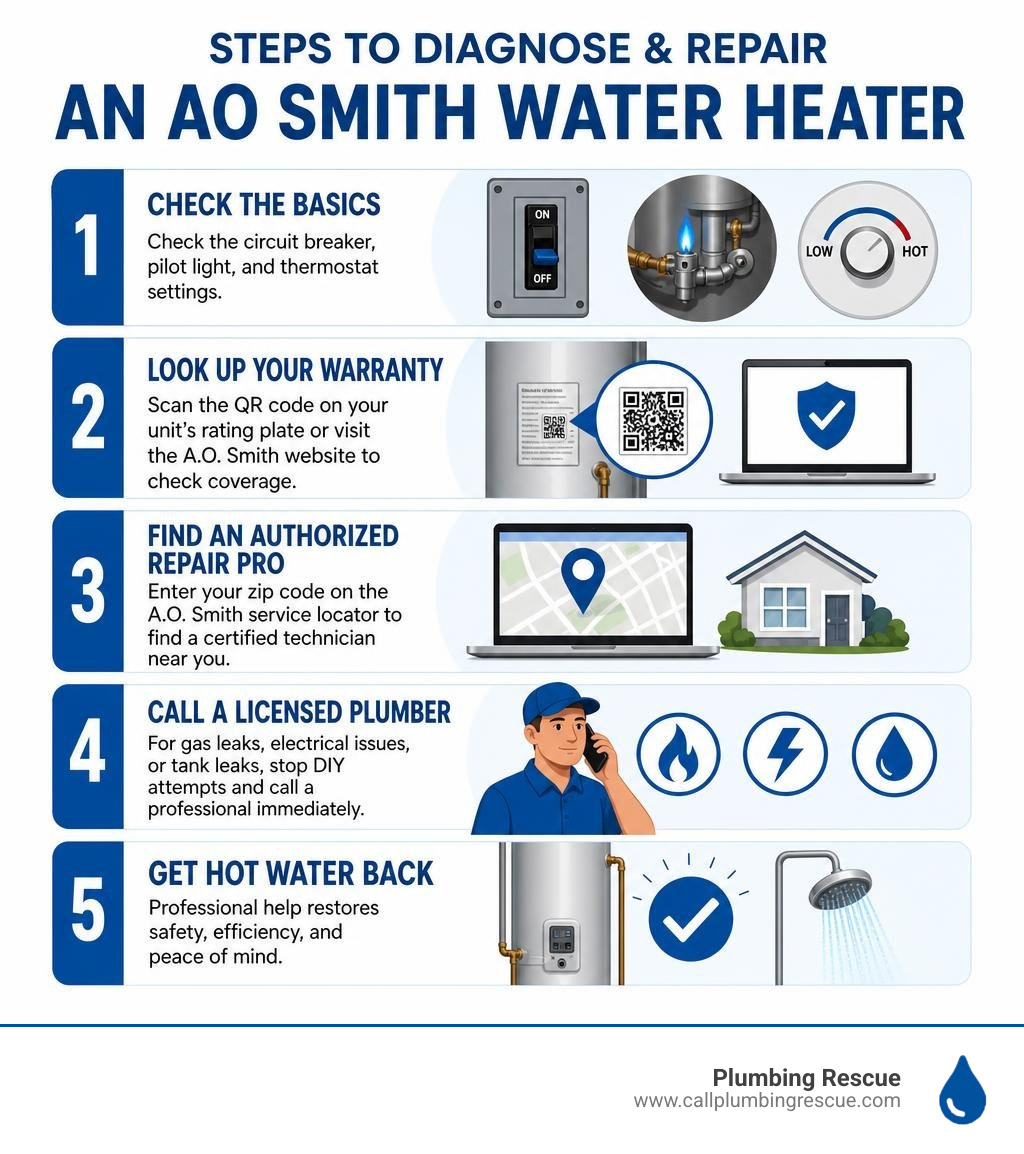
- Check the basics first — Is the circuit breaker tripped? Is the pilot light out? Is the thermostat set correctly?
- Look up your warranty — Scan the QR code on your unit’s rating plate or visit the A.O. Smith website to check coverage.
- Find an authorized repair pro — Enter your zip code on the A.O. Smith service locator to find a certified technician near you.
- Call a licensed plumber — For gas leaks, electrical issues, or tank leaks, stop DIY attempts and call a professional immediately.
Your shower goes cold. You check the unit and something clearly isn’t right. Maybe there’s a puddle on the floor. Maybe the pilot light is out. Maybe nothing obvious is wrong at all — the water just won’t heat up.
This is one of the most stressful household problems a homeowner can face, especially with kids, elderly family members, or a busy morning schedule on the line.
The good news: many A.O. Smith water heater problems are fixable — sometimes quickly and affordably. But knowing who to call and when to call them makes all the difference between a fast fix and a costly mistake.
I’m Ben Smith, a digital marketing strategist with over 25 years of experience helping service businesses — including plumbing and home services companies — connect homeowners with the right professionals fast. Through that work, I’ve developed deep familiarity with the AO Smith water heater repair process and what homeowners actually need to know to make smart, safe decisions. Let’s walk through everything you need to find the right repair pro and get your hot water back.
Quick ao smith water heater repair terms:
Common Problems and Troubleshooting for AO Smith Water Heaters

When you are suddenly met with an icy spray in the shower, your first instinct is probably to panic. Don’t worry, we have been there! Before you start searching for an entirely new system, it helps to understand that water heaters are relatively simple machines. Most issues stem from a few usual suspects.
By familiarizing yourself with Common Water Heater Problems and How to Solve Them, you can often figure out exactly what is going wrong before you even call in the professionals. For a deep technical dive, the A. O. Smith Service Handbook is an invaluable resource that our technicians use in the field to diagnose complex issues.
Troubleshooting No Hot Water and Insufficient Heating
If you have zero hot water, the culprit depends heavily on whether you have a gas or electric model. For electric systems, a tripped circuit breaker or a blown fuse is the most common starting point. If the breaker is fine, you are likely dealing with a burnt-out upper or lower heating element, or a faulty thermostat.
When the water is lukewarm rather than hot, sediment accumulation at the bottom of the tank is often to blame. Over time, minerals in hard water settle at the base of the tank, creating a barrier between the burner or element and the water. This forces your system to work twice as hard to heat the water.
Additionally, A.O. Smith units feature a thermal switch (or high-limit energy cut-off) designed to shut the system down if temperatures exceed safe limits. On modern electronic gas valves, you can look for flashing diagnostic status lights. These LED flash codes correspond to specific errors, such as thermopile voltage issues or sensor failures, which are detailed in your product manual.
Dealing with Water Leaks and Unusual Noises
Water pooling around the base of your unit is a warning sign you should never ignore. First, check the Temperature and Pressure (T&P) relief valve near the top or side of the tank. If this safety valve is dripping, it may be doing its job to release excess pressure, or the valve itself might be failing. Loose fittings and plumbing connections at the top of the tank are also common, easy-to-fix sources of leaks. However, if the water is leaking directly from the bottom of the tank shell, internal corrosion has likely set in, and the tank must be replaced.
If your water heater sounds like it is boiling a witch’s brew of rocks, you are experiencing the classic popping and rumbling noises of heavy sediment buildup. As water trapped beneath the sediment layer boils, it bursts through the mineral crust, creating loud knocking sounds. Regular annual flushing is the best way to prevent this and keep your tank running quietly.
Gas vs. Electric: Key Differences in ao smith water heater repair

Repairing a water heater is not a one-size-fits-all process. Gas and electric models heat water using entirely different energy sources, meaning their troubleshooting paths and components look very different. Understanding these differences can help you decide when to try a quick reset and when to call us for a professional repair. For a comprehensive look at gas systems, you can consult the Standard Residential Gas Water Heater Manual.
Gas Water Heater Repair Challenges
Gas water heaters rely on combustion to heat your water. This means they involve gas control valves, pilot assemblies, thermocouples (or thermopiles), and venting systems.
- Pilot Outage & Thermocouple Failure: If your pilot light refuses to stay lit, the thermocouple is usually the culprit. The thermocouple is a safety device that detects the heat of the pilot flame and generates a tiny electrical current (about 20-30 millivolts). If it fails, the gas control valve will shut off the gas supply to prevent dangerous leaks.
- Combustion Air and Venting: Modern gas units utilize Flammable Vapor Ignition Resistant (FVIR) technology, such as A.O. Smith’s C3 Technology. This design features a sealed combustion chamber, a flame arrestor, and a Lint, Dust, and Oil (LDO) screen. If the LDO screen becomes clogged with dust or pet hair, the burner will be starved of oxygen, causing pilot outages or yellow, sooting flames.
- Manifold Pressure: Testing gas manifold pressure requires specialized manometers. If the gas pressure deviates by more than ±0.3 inches of water column (W.C.) from the specification, the entire gas control valve must be replaced.
Electric Water Heater Repair Challenges
Electric water heaters are structurally simpler than gas models, but they deal with high-voltage electricity (usually 240 volts), which requires extreme caution.
- Tripped Breaker & ECO: If your electric unit stops heating entirely, the first step is checking your home’s breaker panel. Electric models also feature a built-in Energy Cut-Off (ECO) switch on the upper thermostat. If the water gets too hot, this red reset button will trip to cut power.
- Burnt Elements: Electric tanks utilize upper and lower heating elements immersed directly in the water. Over time, these elements can burn out or become grounded.
- Resistance Testing: A technician can easily test these elements using a multimeter. A healthy heating element should read between 5 and 25 ohms of resistance (typically around 12.5 ohms). A reading of zero or infinity means the element has failed and needs to be swapped out.
Repair vs. Replace: Making the Right Decision for Your Unit
When your water heater acts up, the ultimate question is always: Is it worth fixing, or should I just buy a new one?
Generally, traditional tank water heaters have a lifespan of 8 to 12 years, while tankless models can last 15 to 20 years with proper maintenance. If your unit is approaching the end of its typical lifespan, investing in repairs might only be a temporary band-aid. For a complete financial breakdown of this decision, check out Your Wallet Will Love This Affordable Water Heater Replacement Guide.
Here is a quick comparison table to help you weigh your options:
| Factor | Choose Repair | Choose Replacement |
|---|---|---|
| Age of Unit | Under 8 years old | Over 10–12 years old |
| Repair Cost | Under 50% of replacement cost | Over 50% of replacement cost |
| Tank Condition | Dry, no rust or corrosion | Leaking from the inner tank shell |
| Performance | Minor component failure (element, valve) | Frequent breakdowns, high energy bills |
| Efficiency | Standard performance is acceptable | Want to upgrade to save on utility bills |
When to Choose ao smith water heater repair
If your A.O. Smith water heater is under 8 years old and the issue is limited to a single replaceable component—like a bad heating element, a broken thermostat, or a dusty pilot assembly—opting for ao smith water heater repair is almost always the smartest, most cost-effective choice. These quick fixes can get your hot water back online in just a couple of hours and extend the life of your current system without the high upfront cost of a full replacement.
When to Replace Your Water Heater
If your water heater is over 10 years old and has started breaking down regularly, replacement is usually the wiser long-term investment. Most importantly, if your tank is actively leaking from the bottom, it cannot be repaired. The inner steel tank has corroded through, and a complete replacement is your only option.
Upgrading to a newer, energy-efficient model can also pay off quickly. Modern high-efficiency and hybrid heat pump models can save enough on utility bills to completely pay for themselves within 4 to 5 years.
Understanding Repair Costs and the AO Smith Warranty Process
Before you open your wallet for a repair, it is crucial to understand how much you should expect to pay and whether A.O. Smith’s manufacturer warranty will cover the costs. If you need to plan your budget, read our guide on how to Fix Your Tank for Less with Affordable Water Heater Repair.
How the AO Smith Warranty Works
A.O. Smith offers excellent warranties, ranging from 6 to 10 years on premium residential models. To check your warranty status:
- Locate the rating plate on the side of your water heater.
- Find the serial number and model number, or simply scan the built-in QR code with your smartphone.
- Visit the Water Heater Warranty Repair Service Near Me page to verify your coverage.
Important Warranty Note: Standard manufacturer warranties cover the cost of replacement parts, but they typically do not cover labor costs after the first year. This means that while A.O. Smith may ship you a free replacement gas valve or heating element, you will still need to pay a licensed plumber for the diagnostic and installation labor.
Typical Costs for Common Repairs
If your unit is out of warranty, or if you are paying for local labor, here are the typical costs associated with common water heater repairs in June 2026:
- Anode Rod Replacement: $150 – $300 (Part cost is around $50. Replacing this rod every 3 to 5 years prevents tank corrosion).
- Heating Element Replacement: $150 – $300 (Elements themselves cost $10 – $60).
- Thermostat Replacement: $150 – $250 (Thermostats cost roughly $20).
- Gas Control Valve: $350 – $600 (The valve part is $300 – $500).
- T&P Relief Valve: $150 – $250 (The safety valve part is around $15).
How to Find Authorized AO Smith Water Heater Repair Pros
When it comes to water heater repairs, choosing the right technician is just as important as using the right parts. Because water heaters deal with high-voltage electricity, pressurized water, and natural gas, incorrect repairs can lead to severe water damage, electrical fires, or carbon monoxide leaks.
Why Hire an Authorized ao smith water heater repair Specialist?
Authorized A.O. Smith technicians receive specialized training directly from the manufacturer. They understand the unique engineering of A.O. Smith systems, including proprietary features like Blue Diamond glass coatings, CoreGard anode rods, and FVIR burner assemblies. Hiring an authorized specialist ensures that:
- Your manufacturer’s warranty remains valid.
- Only genuine OEM (Original Equipment Manufacturer) parts are used.
- Complex diagnostic tools (like checking thermocouple millivolts or gas manifold pressure) are performed safely and accurately.
Steps to Locate Certified Technicians Near You
Finding a qualified professional in your area is simple. If you live in one of our service locations—such as Austin, TX, Denver, CO, Indianapolis, IN, or Phoenix, AZ—you can easily find certified help.
- Use the Official Locator: Go to the A.O. Smith Find a Service Provider for Your Water Heater page and enter your zip code.
- Austin Residents: If you are in the Lone Star State, you can go directly to the Find an Authorized Water Heater Installer in Austin, TX directory.
- Verify Credentials: Always ensure the plumbing company you hire is fully licensed, bonded, and insured in your specific state.
- Check Emergency Availability: Water heater emergencies rarely happen during convenient business hours. Look for local providers who offer reliable 24/7 service.
Frequently Asked Questions about AO Smith Water Heaters
Can I perform DIY repairs on my AO Smith water heater?
While homeowners can easily handle basic maintenance tasks—like checking a tripped circuit breaker, relighting a pilot light, or performing an annual tank flush—most repairs should be left to the pros. Working on gas lines, high-voltage electrical connections, and highly pressurized systems carries significant safety risks. An incorrect DIY repair can lead to gas leaks, carbon monoxide exposure, electrical shock, or catastrophic water damage, and will likely void your manufacturer’s warranty.
How long do AO Smith water heaters typically last?
On average, an A.O. Smith traditional tank water heater will last between 8 and 12 years. If you own an A.O. Smith tankless model, you can expect it to last 15 to 20 years. These lifespans depend heavily on your local water quality and how regularly the unit is maintained. If you live in an area with very hard water and never flush the tank or check the anode rod, your system’s lifespan can be cut in half.
What should I do if my water heater is leaking from the bottom?
If you notice water pooling directly underneath your water heater tank, you should immediately take action:
- Turn off the power: Shut off the circuit breaker for an electric unit, or turn the gas control valve to “OFF” for a gas unit.
- Shut off the water: Locate the cold water shut-off valve on the pipe leading into the top of the heater and turn it clockwise to stop the flow of water.
- Call a professional: A leak coming directly from the bottom of the tank shell indicates that the internal glass lining has failed and the metal has corroded through. This cannot be patched; the unit must be replaced.
Conclusion
A failing water heater can quickly disrupt your entire household, but getting your hot water back doesn’t have to be a stressful ordeal. By understanding the common signs of trouble, knowing the differences between gas and electric systems, and verifying your warranty coverage, you can make a smart, informed decision for your home.
When you need rapid, reliable, and professional help, Plumbing Rescue is here for you. We provide 24/7 emergency plumbing services, including expert leak detection, rapid repairs, and complete water heater replacements. With our rapid call routing to local technicians, we ensure you get urgent, day-or-night assistance across our service areas, including Austin, TX, Denver, CO, Indianapolis, IN, and Phoenix, AZ.
Don’t suffer through another cold shower. Contact Plumbing Rescue for Affordable Water Heater Repair today, and let our licensed pros get your hot water flowing again!
Dealing With This Yourself? Talk to a Licensed Plumber.
Skip the guesswork — get a straight answer from a local pro. Available 24/7, no forms, no waiting.
Call Now: (888) 686-0698