
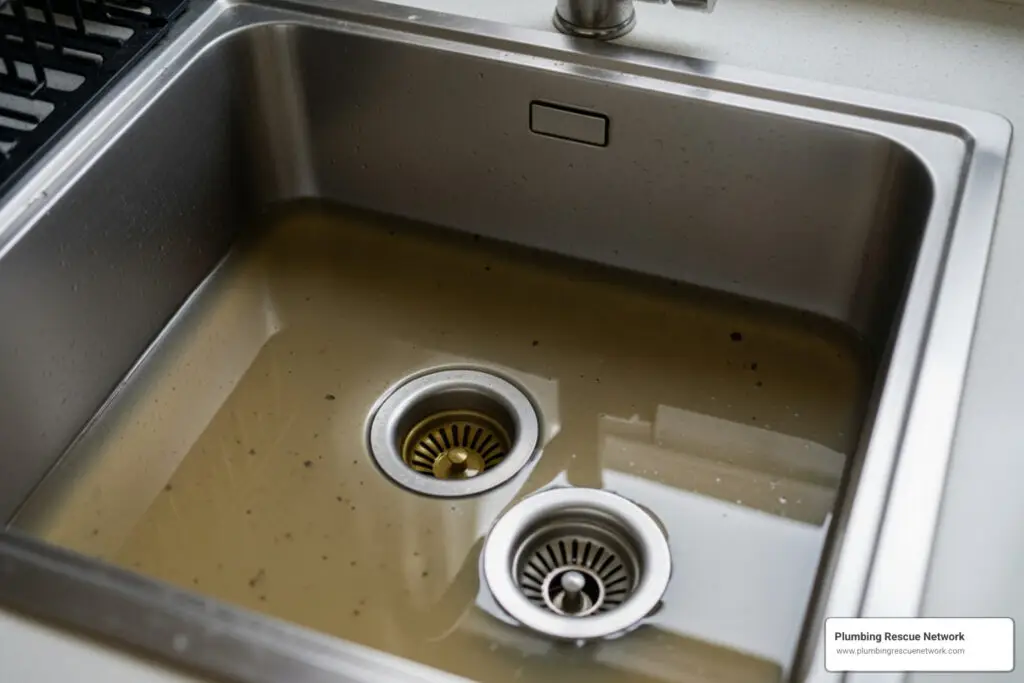
When Your Sink Fights Back: What to Do About a Backed Up Sink and Garbage Disposal
A backed up sink and garbage disposal is one of the most common — and most frustrating — kitchen plumbing problems a homeowner can face. One minute you’re rinsing dishes, the next you’re staring at murky water that won’t drain, a foul smell rising from the drain, and a disposal that hums along like nothing is wrong.
Here’s a quick answer to fix a backed up sink and garbage disposal:
- Turn off and unplug the garbage disposal before doing anything else
- Check for visible debris in the sink drain and disposal opening
- Remove and clean the P-trap (the U-shaped pipe under the sink)
- Snake the drain line where it enters the wall
- Reassemble, flush with hot water, and test
If multiple drains in your home are backing up at the same time, skip the DIY steps — that’s a main sewer line issue requiring a professional.
The good news: most backups are caused by a clog in the drain line, not a broken disposal. That means you can often fix it yourself with basic tools and about 30 minutes of time.
I’m Ben Smith, a digital marketing strategist who has spent over 25 years working closely with plumbing and home service businesses — including helping homeowners find fast, reliable solutions for emergencies like a backed up sink and garbage disposal. That experience has given me a front-row seat to the most common mistakes people make when tackling this problem, and exactly what works.

Common Causes of a Backed Up Sink and Garbage Disposal
When we receive calls in Council Bluffs about a kitchen sink that won’t drain, the culprit is rarely a mechanical failure of the motor. Instead, it is usually a physical obstruction. Understanding why your Garbage Disposal Backs Up Into Sink (Solved) starts with looking at what we put down the drain.
The most common cause is food waste overload. Garbage disposals are designed for light food residue, not as a secondary trash can. When too much material is shoved down at once, the “slurry” created is too thick for the pipes to carry away. This leads to grease solidification. Even if you don’t pour liquid bacon grease down the drain, fats from meats and butter cling to the pipe walls. As the water cools, this grease hardens, catching other food particles like a spider web.
Another frequent issue is starchy expansion. Foods like pasta, rice, and potato peels contain high levels of starch. When these hit water, they swell. A small handful of spaghetti can turn into a thick, glue-like paste that completely seals off the drain pipe. Furthermore, as a disposal ages, it may suffer from dull impellers. While many people think disposals have sharp blades, they actually use blunt impellers to fling food against a grind ring. If these impellers become dull or coated in grime, they can’t break food down small enough, leading to clogs further down the line.

| Safe for Disposal | NEVER Put Down Disposal |
|---|---|
| Soft food scraps | Fats, Oils, and Grease (FOG) |
| Small fruit pits (citrus) | Coffee grounds |
| Liquid dish soap | Pasta, Rice, and Bread |
| Ice cubes (for cleaning) | Fibrous veggies (celery, corn husks) |
| Cold water | Eggshells and Potato peels |
Why the Backup Hits the Other Side of a Double Sink
If you have a double sink, you might notice a strange phenomenon: you run the disposal on the right side, and dirty water gurgles up into the left side. This happens because of pressure dynamics and the “path of least resistance.”
In a standard double sink setup, both basins eventually meet at a shared drain line using a component called a double-basin tee. If there is a clog located past this junction—usually in the P-trap or the pipe entering the wall—the water has nowhere to go. When the disposal turns on, it acts like a pump, forcing water down. Since the main exit is blocked, the water is pushed back up through the other sink’s tailpiece. According to Why Is My Garbage Disposal Backing Up Into the Other Sink?, this is a classic sign that the blockage is downstream from where the two pipes connect.
The Role of the Dishwasher Connection
Many homeowners in Council Bluffs don’t realize their dishwasher and garbage disposal are “roommates.” The dishwasher drains through a hose that connects directly to a nipple on the side of the garbage disposal.
If your sink is backed up, your dishwasher likely won’t drain properly either. Without a proper air gap (that little silver cylinder on top of your sink) or a high loop in the drain hose, the pressure from a backed-up disposal can actually force dirty sink water back into your dishwasher. This is not only gross but can leave a foul odor on your clean dishes.
Why DIY Methods Like Plunging and Baking Soda Often Fail
We’ve all seen the “life hacks” suggesting that a mixture of baking soda and vinegar can clear any clog. While this makes for a great elementary school science project, it is rarely effective for a backed up sink and garbage disposal.
When you mix baking soda (a base) and vinegar (an acid), they undergo a chemical neutralization. The resulting foam—the “volcano effect”—looks impressive, but it lacks the caustic power to dissolve grease or the mechanical force to move a solid clog. At best, it might freshen the smell of your drain; at worst, it does nothing while the water continues to rise.
Plunging is another area where people often go wrong. If you have a dishwasher connected, aggressive plunging can force debris into the dishwasher’s internal pump, causing expensive damage. Furthermore, most people use the wrong tool. You should use a sink plunger, which has a flat cup. A toilet plunger, which has a fold-out flange on the bottom, won’t create the necessary airtight seal against the flat bottom of a kitchen sink. For professional-grade results, some homeowners opt for “master” or “pro” sink plungers, which are designed specifically to create high-volume pressure in kitchen drains.
Step-by-Step Guide to Clearing the Clog Safely
If your sink is holding water, it’s time to roll up your sleeves. Safety is paramount when dealing with an appliance that has a motor and moving parts.
- Disconnect the Power: Unplug the disposal from the wall outlet under the sink. If it is hard-wired, turn off the circuit breaker. Never put your hand in a disposal that has power.
- Prepare for a Mess: Place a sturdy bucket directly under the P-trap (the U-shaped pipe). This pipe is currently full of stagnant, smelly water.
- P-trap Removal: Loosen the large plastic slip nuts at both ends of the U-pipe. You can usually do this by hand, but if they are stuck, use channel-lock pliers gently.
- Inspect and Clean: Pull the P-trap away. Empty the water into your bucket. Use a bottle brush or an old coat hanger to fish out the gunk inside the “U.” This is where most grease and hair clogs live.
- Manual Inspection: While the trap is off, check the horizontal “trap arm” that leads into the wall. If you see a wall of sludge, you’ve found your problem.
How to Use a Drain Snake on a Backed Up Sink and Garbage Disposal
If the P-trap was clear, the clog is deeper in the wall. This is where a drain snake (also called a pistol drum auger) comes in.
With the P-trap removed, you have a direct opening into the drain pipe at the wall. Feed the end of the snake into the wall pipe manually until you feel resistance. This is the clog. Tighten the lock on the snake and turn the handle clockwise. This “drills” the snake into the blockage. Pull the snake back slightly to break up the debris, then feed it further. Once you’ve cleared the obstruction, retract the cable, reassemble the pipes, and flush the system with plenty of hot water to wash away any remaining residue.
Signs of a Deeper Main Line Clog vs. a Simple Trap Clog
How do you know if your DIY efforts are enough? A simple trap clog usually only affects the kitchen sink. However, there are red flags that point to a much more serious issue in your home’s main sewer line:
- Multiple Fixture Backups: If you run the kitchen sink and water starts coming up in the basement floor drain or a nearby bathroom, the clog is in the main stack.
- Sewer Gas Smells: A persistent “rotten egg” smell throughout the house often indicates a venting issue or a deep main line blockage.
- Gurgling Toilets: If your toilet bubbles when you run the kitchen sink, the two systems are fighting for drainage space due to a deep clog.
In these cases, a hand snake won’t reach the problem. You need a professional with a camera inspection tool to see what’s happening deep underground.
Preventing Future Issues with Your Backed Up Sink and Garbage Disposal
The best way to handle a backed up sink and garbage disposal is to make sure it never happens in the first place. Proper maintenance is simpler than you think.
- Cold Water is Key: Always run cold water before, during, and after using the disposal. Cold water keeps fats and grease in a solid state so the impellers can chop them up. Hot water melts grease, allowing it to coat your pipes further down the line.
- The Ice Cube Trick: Once a month, toss a handful of ice cubes and a splash of dish soap into the disposal. The hard ice helps “scour” the impellers and the grind ring, removing the slimy buildup that causes slow grinding.
- Citrus Deodorizing: Throwing a few lemon or orange peels down the drain isn’t just for the smell—the natural oils help break down fatty residues.
- Small Batches: Feed food scraps in slowly. Don’t dump a whole plate of leftovers in at once.
- Use a Strainer: For items that shouldn’t go down the disposal, use a mesh sink strainer. It’s much easier to empty a strainer into the trash than it is to take apart your plumbing.
For residents in our area, local guidelines for Garbage, Yard Waste and Recycling Collection often recommend composting or disposing of heavy organic waste in the trash rather than the sewer system to protect our local infrastructure.
Frequently Asked Questions about Kitchen Backups
What foods should never go down a garbage disposal?
You should avoid “The Big Three”: Fats/Oils/Grease, Starches (pasta, rice, potato peels), and Fibrous vegetables (celery, onion skins, corn husks). Fibrous materials act like dental floss, wrapping around the motor shaft and causing it to seize. Coffee grounds are also a major “no-no”—they don’t dissolve and instead settle in the P-trap like heavy silt.
How do I safely unjam the disposal blades?
If your disposal hums but won’t spin, it’s jammed. Most units come with a small hex key (Allen wrench). Underneath the disposal, in the center of the bottom housing, there is a small hole. Insert the hex key and turn it back and forth. This manually rotates the motor to break the jam. Once it moves freely, press the small red reset button on the bottom of the unit, plug it back in, and try again.
When is it time to call a professional plumber?
You should call us if:
- The motor hums even after you’ve used the hex key to unjam it.
- You see water leaking from the bottom of the disposal unit itself (this usually means an internal seal has failed).
- Water is backing up into multiple rooms.
- You’ve snaked the line and the backup returns within 24 hours.
Conclusion
Tackling a backed up sink and garbage disposal can feel like a daunting task, but with the right approach, most homeowners in Council Bluffs can resolve minor clogs on their own. However, plumbing systems are complex, and sometimes a simple clog is a symptom of a much larger issue.
If you’ve tried the P-trap cleaning and the snake, but your sink is still refusing to cooperate, don’t risk damaging your pipes with harsh chemicals or excessive force. At Plumbing Rescue Network, we specialize in rapid response for these exact situations. We provide 24/7 emergency plumbing services throughout Council Bluffs, IA, ensuring that a kitchen backup doesn’t turn into a weekend-long nightmare. Whether it’s a stubborn kitchen clog, a leak, or a water heater issue, our local technicians are ready to get your home flowing again. Give us a call, and let us take the “gross” out of your DIY!

