
When Your Bathroom Drain Is Clogged: What to Do Right Now
A bathroom drain clogged with hair, soap scum, or debris is one of the most common household plumbing problems — and one of the most fixable. Here’s a quick answer if you need it fast:
How to unclog a bathroom drain (fastest methods first):
- Pull visible hair from the drain opening with tweezers or needle-nose pliers
- Pour baking soda then vinegar (½ cup each), cover the drain, wait 15 minutes, flush with hot water
- Use a Zip-It tool or drain snake to pull out deeper hair clogs
- Plunge the drain using a cup plunger with enough water to cover the cup
- Clean the P-trap under the sink if water still won’t move
- Call a plumber if multiple drains are slow, you smell sewage, or nothing works
That slow drain isn’t just annoying — it usually gets worse fast, especially in multi-person households where hair and soap scum build up in as little as 30 to 60 days. What starts as a slightly sluggish sink can turn into standing water that disrupts your entire morning routine.
The good news? About 80% of bathroom drain clogs can be cleared at home with basic tools and a little patience. You don’t need harsh chemicals or an expensive service call to fix most blockages.
I’m Ben Smith, a digital marketing consultant and growth strategist who has spent over 25 years working alongside service businesses — including plumbing companies dealing with the full spectrum of bathroom drain clogged emergencies. In this guide, I’ll walk you through exactly what works, what doesn’t, and when it’s time to call in a pro.
Easy bathroom drain clogged glossary:
Why is Your Bathroom Drain Clogged?
To successfully clear a stubborn clog, it helps to understand what is actually happening beneath the drain grate. Unlike kitchen sinks, which primarily deal with food particles and cooking grease, bathroom drains face a completely different set of elements.
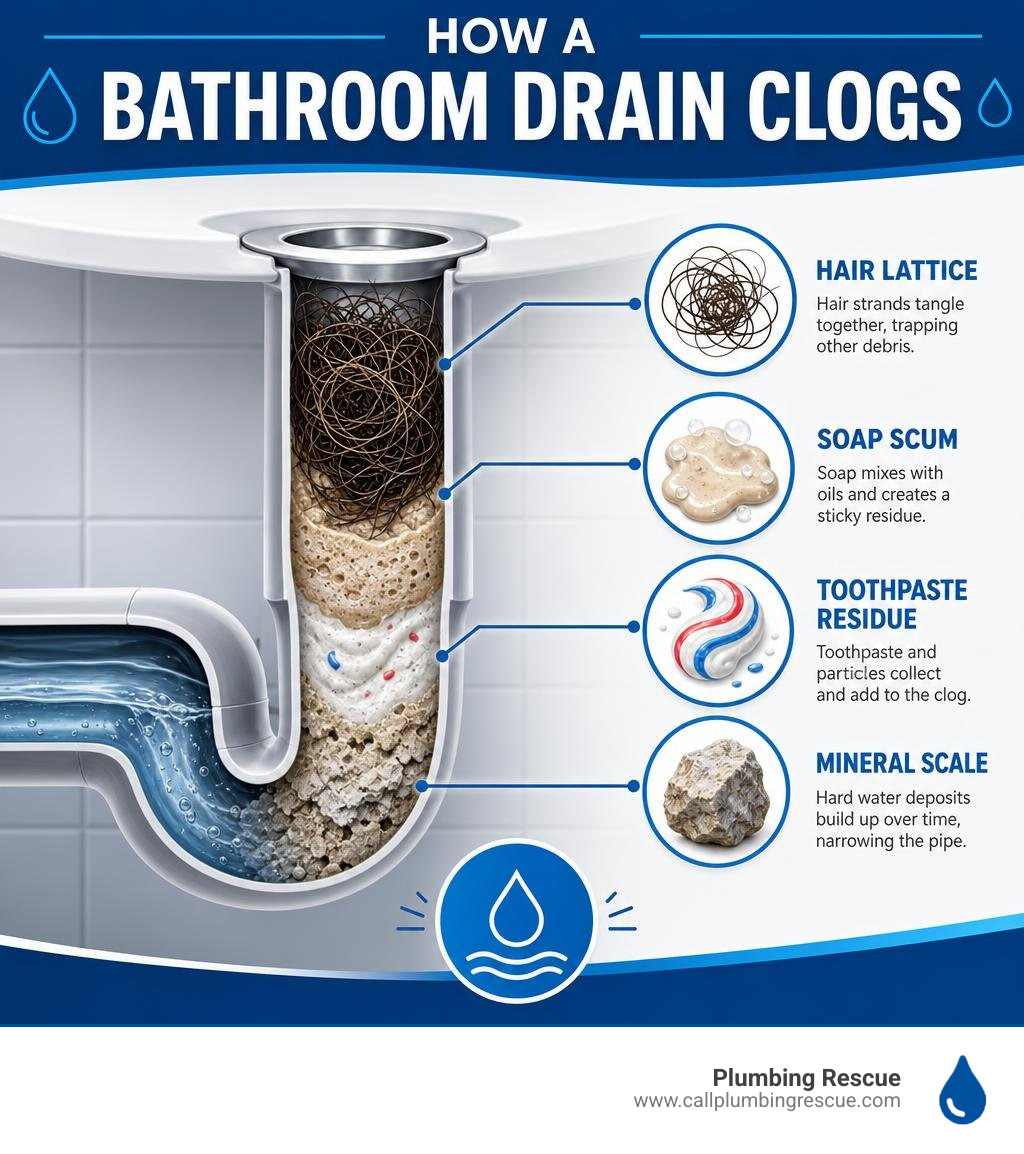
When your bathroom sink, shower, or tub refuses to drain, it is almost always due to a combination of hair, soap scum, toothpaste residue, and mineral scale. These elements do not just sit loosely in the pipe; they chemically and physically bond to form a dense, sticky obstruction.
As water flows down, these materials collect at restriction points—most commonly around the pop-up stopper mechanism or inside the U-shaped bend of the P-trap. For a detailed breakdown of how these patterns develop, you can read about Why Does Bathroom Drain Back Up? Common Causes, Signs, and Fixes for 2026 – sprucebath.com.
When these materials begin to restrict water flow, the drain speed slows down gradually. If your sink takes several minutes to empty, or if you hear a soft “gulping” sound as the water finally disappears, the pipe’s internal diameter has likely been narrowed significantly by clinging residue. You can learn more about diagnosing these early warning signs in Why Is My Bathroom Sink Not Draining (And How to Fix It in 10 Minutes), HomeFixer101.
Common Culprits Behind a Bathroom Drain Clogged with Hair
Hair is the undisputed number-one cause of bathroom drain clogs. Every time we wash our hair, shave, or brush our teeth over the sink, loose strands slip down the drain.

Once inside the pipe, hair behaves like a structural lattice. A single strand of hair easily passes through, but as multiple strands catch on the drain stopper or rough pipe walls, they begin to tangle. This hair lattice then acts as a net, capturing soap scum, toothpaste, and skin oils.
In multi-person households, this hair accumulation can reduce water flow dramatically within just 30 to 60 days. The problem is intensified by bar soaps, which leave behind a waxy, sticky film. This waxy film acts like glue, binding the hair strands into a solid, water-resistant plug.
Fortunately, this is also one of the easiest issues to prevent. Simply installing a cheap mesh drain strainer can reduce the volume of hair entering your drainage system by up to 80%, saving you from frequent DIY clearing sessions.
Other Hidden Reasons for a Bathroom Drain Clogged with Debris
While hair and soap are the primary offenders, other everyday personal care products play a significant role in creating a bathroom drain clogged with debris:
- Bath Oils and Exfoliating Scrubs: Heavy bath oils, body butter, and thick exfoliating scrubs do not always wash away completely. As they cool down inside the dark, cold pipes under your floor, they solidify and coat the pipe walls, catching other debris.
- Shaving Cream and Toothpaste: These products are designed to be thick and viscous. If they are not flushed down with plenty of hot water, they cling to the drain tailpiece and harden into a sticky paste.
- Foreign Objects: Bobby pins, dental floss, cotton swabs, and dental picks frequently fall into open drains. Because they do not dissolve, they lodge in the P-trap and act as perfect anchors for hair.
- Flushable Wipes: Despite marketing claims, “flushable” wipes do not break down in plumbing systems like standard toilet paper. They remain intact, catch on pipe imperfections, and cause massive blockages. To put this in perspective, the City of New York spent $18 million over a five-year period dealing with wipes and similar debris clogging its municipal wastewater infrastructure.
Safe and Effective DIY Methods to Clear the Blockage
Before you reach for the phone to call in a professional, we highly recommend trying a few safe, physical, and natural DIY methods. Roughly 80% of residential drain clog service calls can actually be resolved at home with basic tools, a bit of patience, and the right approach.

We always advise starting with the gentlest, non-chemical methods first. This protects your household pipes from chemical corrosion and keeps your family safe from toxic fumes. For a look at which home remedies deliver the best results, check out Bathroom Drain Clog Fixes That Actually Work.
If you are considering commercial options, make sure to read The Ultimate Guide To The Best Drain Cleaners On The Market to understand which products are safe for your specific pipe materials.
The Baking Soda and Vinegar Method
If your drain is running slow but has not completely backed up with standing water, the classic baking soda and vinegar method is an excellent, eco-friendly first step. This chemical reaction relies on simple kitchen chemistry: sodium bicarbonate (baking soda) is a mild base, while white vinegar (acetic acid) is a mild acid.
When these two substances meet inside the pipe, they react to create carbon dioxide gas. This rapid, fizzing bubbling action creates physical pressure that can loosen sticky soap scum, toothpaste, and light organic debris from the pipe walls. For a complete step-by-step walkthrough, refer to How to Unclog a Bathroom Drain with Baking Soda: A Practical 2026 Guide – sprucebath.com.
Here is how to perform this method effectively:
- Remove Standing Water: This method will not work if the sink or tub is full of water, as the water will dilute the mixture before it reaches the clog. Use a cup to scoop out any standing water.
- Pour the Baking Soda: Pour exactly ½ cup of dry baking soda directly down the drain opening. Use a funnel or a spoon to make sure it goes deep into the pipe.
- Add the Vinegar: Slowly pour ½ cup of white vinegar down the drain.
- Cover the Drain: Immediately seal the drain opening with a stopper, a rag, or a cup. Sealing the opening is crucial because it forces the fizzing carbon dioxide expansion downward toward the clog rather than up into your sink.
- Wait and Flush: Let the mixture bubble and work its magic for 15 to 30 minutes. While you wait, heat a kettle of water (use hot tap water if you have plastic PVC pipes to avoid warping them). Flush the drain thoroughly with the hot water to wash away the loosened debris.
If you are dealing with a clogged toilet rather than a sink or shower, a similar chemical approach can be used. You can read our guide on How To Unblock A Toilet Using Baking Soda And Vinegar for tailored instructions.
Mechanical Extraction: Zip-It Tools and Plumbers’ Snakes
If a natural chemical reaction does not clear the path, it is time to use mechanical tools. For bathroom drains, physical extraction is almost always the most successful route because it directly targets the physical hair mass.
The Zip-It tool is a thin, flexible plastic strip covered in sharp, backward-facing barbs. It is incredibly cheap (typically costing around $4) and is arguably the most effective tool for clearing hair clogs located close to the drain opening.
To use it, gently feed the plastic strip down into the drain grate or past the pop-up stopper as far as it will go. Twist it slightly, and then pull it slowly back out. The backward-facing barbs will hook onto the hair lattice, allowing you to pull out the entire slimy plug in under two minutes.
For deeper blockages that sit past the P-trap, you will need a plumbing auger (often called a drain snake). A hand-cranked plumbing auger features a flexible steel cable with a corkscrew tip. Feed the cable into the drain until you feel resistance. Crank the handle to rotate the cable, which allows the corkscrew tip to bite into and grab the clog. Slowly retrieve the cable to pull the blockage out.
If the clog is stubborn, you can perform a P-trap disassembly. The P-trap is the U-shaped pipe located directly underneath your sink. It is designed to hold a small amount of standing water, which acts as a barrier to keep sewer gases from entering your home. Because of its sharp bend, it is also a primary collection point for heavy clogs.
To clean it, place a bucket beneath the trap to catch any spilled water. Unscrew the slip nuts on either end of the U-shaped pipe using channel-lock pliers (or your hands if they are plastic). Remove the pipe section, empty any accumulated hair and debris into the bucket, rinse the pipe clean, and reassemble it. Be careful to only hand-tighten plastic slip nuts plus an extra quarter-turn; overtightening can easily crack the plastic threads.
| DIY Method | Best Clog Type | Average Cost | Effectiveness | Pipe Safety |
|---|---|---|---|---|
| Hot Water Flush | Light soap scum & toothpaste | $0 | Low | High (Avoid boiling water on PVC) |
| Baking Soda & Vinegar | Light organic buildup & odors | Under $5 | Medium | High |
| Zip-It Plastic Tool | Shallow hair clogs | $4 | High | High |
| Cup Plunger | Localized blockages | $5 – $15 | Medium-High | High |
| Plumbing Auger (Snake) | Deep hair & debris clogs | $25 – $50 | High | Medium (Can scratch old pipes) |
| P-Trap Disassembly | Heavy blockages in sink bend | $0 (Requires pliers) | High | High (If reassembled carefully) |
When to Stop DIY Fixes and Call a Professional
While taking a DIY approach to a bathroom drain clogged with hair can be satisfying and cost-effective, there comes a point where continuing to push, plunge, or snake can do more harm than good. Roughly 20% of residential drain blockages require professional-grade equipment and advanced diagnostic tools to resolve safely.
Knowing when to step back can save you from cracked pipes, major water damage, and expensive repairs. If you have tried plunging, snaking, and natural flushing with zero improvement, it is time to call in the experts.
For a complete overview of how professional teams tackle complex blockages, explore our guide on Smart Solutions For Every Blocked Drainage System. If you are facing an active backup that is threatening to flood your bathroom, do not hesitate to contact our 24 Hr Drain Service For When Life Gets Clogged.
Signs of a Deeper Sewer Line Issue
How do you differentiate between a simple, localized bathroom clog and a severe, deep-seated plumbing emergency? Look for these critical warning signs:
- Multiple Slow Drains: If your bathroom sink, shower, and toilet are all draining slowly or backing up at the same time, the issue is not localized to one fixture. You are likely dealing with a blockage in the main sewer line.
- Water Backing Up Into Other Fixtures: If you flush your toilet and water bubbles up into your bathtub or shower, or if running your bathroom sink causes the toilet bowl water level to rise, you have a major downstream blockage.
- Gurgling Toilets: If your toilet constantly gurgles or bubbles when you run water in the sink or shower, air is trapped in the drain system due to a blocked main line or a clogged roof vent stack.
- Persistent Sewer Odors: A strong, rotten-egg sewer smell that lingers throughout your bathroom or basement indicates that sewer gases are escaping, which often points to a cracked pipe or a deep sewer line backup.
In older residential neighborhoods across our service areas—such as historic districts in Austin, TX, Denver, CO, Indianapolis, IN, and Phoenix, AZ—sewer lines were often constructed using cast-iron pipes or clay sewer laterals. Over decades, cast-iron pipes corrode from the inside out, creating rough, rusty surfaces that catch debris.
Worse, clay sewer laterals are highly vulnerable to tree root intrusion. Tiny tree roots find microscopic cracks in the clay pipes, grow inside to access the water, and eventually create a solid, impenetrable root mass that blocks all household wastewater.
When dealing with deep-seated main line issues, professional plumbers use specialized services like high-pressure hydro jetting (which blasts water through the pipes at up to 4,000 PSI) and sewer camera inspections to locate and clear the blockage. If you are located in any of our service areas, having a licensed technician inspect your system is the safest way to protect your home from sewage backups.
For our readers in these regions, professional drain cleaning services are readily available to handle tough blockages:
- Austin, TX: Local specialists can perform camera inspections to locate the exact source of your main line blockage.
- Denver, CO: Experienced technicians offer rapid support to clear stubborn clogs and restore proper flow.
- Indianapolis, IN: Reliable local plumbers provide comprehensive drain clearing and sewer line maintenance.
- Phoenix, AZ: Expert drain cleaning services are available to resolve deep-seated clogs and prevent recurring backups.
Frequently Asked Questions About Clogged Bathroom Drains
Can I use chemical drain cleaners like Drano?
We strongly advise against using liquid chemical drain cleaners. While they are heavily marketed as quick fixes, products like Drano rely on harsh, caustic chemicals (like sodium hydroxide or sulfuric acid) to dissolve clogs.
These chemicals generate an intense exothermic (heat-producing) reaction inside your pipes. This extreme heat can easily soften, warp, and melt PVC plastic pipes, or crack older, fragile cast-iron and clay pipes.
Furthermore, chemical cleaners can eat away at the rubber gaskets and seals inside your drain assemblies, leading to hidden leaks under your vanity. Finally, if the chemical cleaner fails to clear the clog, you are left with a basin full of highly toxic, acidic standing water. This poses a major chemical burn hazard to you and any plumber who has to disassemble the pipes afterward.
How often should I clean my bathroom sink stopper?
To prevent severe clogs from forming, you should clean your pop-up stopper every 6 months for a heavily used master bathroom, and at least once a year for guest bathrooms.
Most modern bathroom sink stoppers are held in place by a pivot rod underneath the sink. To clean it, go under the sink, unscrew the retaining nut holding the horizontal pivot rod in place, pull the rod back slightly, and then lift the stopper straight out of the sink basin. Wipe away the accumulated hair, soap scum, and black slime, rinse the stopper, and reinstall it. This quick, five-minute maintenance habit prevents 90% of bathroom sink clogs.
Why does my bathroom drain keep clogging every few weeks?
If your bathroom drain backs up again just a few weeks after you clear it, it usually means one of three things:
- The Clog Was Only Partially Cleared: Using a plunger or a basic snake often just punches a small hole through the center of a hair clog. While water will flow temporarily, the remaining sticky hair mass quickly catches new debris and closes up again.
- Heavy Mineral Scale: If you live in a hard water area (which is incredibly common in cities like Phoenix, AZ and Austin, TX), calcium and magnesium deposits build up inside your pipes over time. This mineral scale creates a rough, sandpaper-like surface that catches hair and soap scum, causing rapid, recurring clogs.
- Underlying Structural Damage: Recurring clogs can be a sign of a sagging pipe (a “belly” where water pools), a cracked line, or tree root intrusion. If a drain keeps failing, we highly recommend scheduling a professional sewer camera inspection to see exactly what is happening inside the pipe.
Conclusion
A bathroom drain clogged with hair, soap scum, or toothpaste is a frustrating disruption, but it is a problem you can usually handle yourself using natural flushing methods or simple mechanical tools like a Zip-It or a plunger. By adopting simple prevention habits—like installing mesh drain strainers and cleaning your pop-up stoppers regularly—you can keep your plumbing flowing smoothly.
However, when DIY methods fall short, or if you are facing warning signs of a deeper main sewer line issue, don’t risk damaging your home’s pipes.
At Plumbing Rescue, we provide 24/7 emergency plumbing services, including rapid leak repairs, water heater solutions, and professional drain clearing across our service locations in Austin, TX, Denver, CO, Indianapolis, IN, and Phoenix, AZ. Our unique call routing connects you to local, licensed technicians in your neighborhood for urgent, day-or-night help.
If you are dealing with a stubborn clog that won’t budge, skip the stress and the harsh chemicals. Get professional drain cleaning services today and let our expert team restore your peace of mind.
Dealing With This Yourself? Talk to a Licensed Plumber.
Skip the guesswork — get a straight answer from a local pro. Available 24/7, no forms, no waiting.
Call Now: (888) 686-0698