

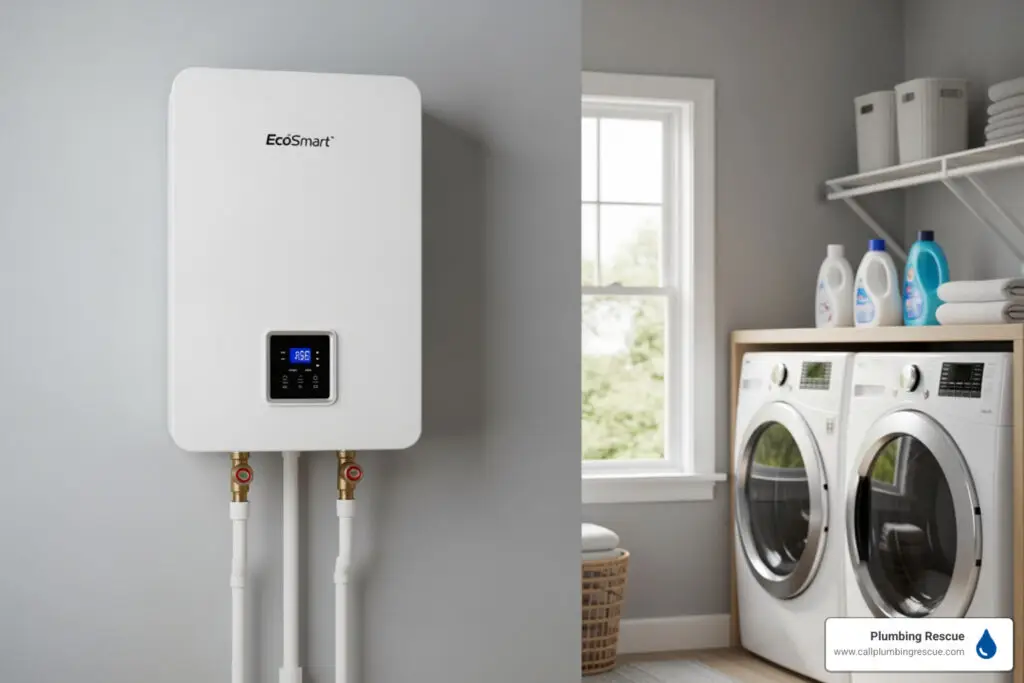
When Your EcoSmart Tankless Water Heater Stops Working
EcoSmart tankless water heater repair is something many homeowners face at the worst possible moment — cold shower, no warning, and no idea where to start.
Here are the most common fixes, fast:
| Problem | Quick Fix |
|---|---|
| No hot water, no display | Check circuit breaker and power supply |
| E1 or E2 error code | Test or bypass thermistor (hold knob 3-5 sec) |
| E4 error | Incoming water temp too high (above 150°F) |
| E5 error | Flow rate too high — install a flow restrictor |
| S103 error | Voltage too low — verify at least 208V supply |
| No LED with water flow | Clean flow meter impeller |
| Lukewarm water only | Test heating elements (should read 6-10 ohms) |
EcoSmart’s ECO series units are built to last over 20 years — but like any appliance, they develop problems. The good news? Many common issues follow predictable patterns, and with the right steps, you can diagnose them quickly.
This guide walks you through every major issue, from error codes to failed components to maintenance that prevents breakdowns before they happen.
I’m Ben Smith, a digital marketing and home services consultant who has helped hundreds of plumbing businesses develop repair content resources — including material specifically covering EcoSmart tankless water heater repair diagnostics and component testing. This guide is built on official EcoSmart troubleshooting documentation and real-world repair experience, so you can move from problem to solution without wasting time.

Ecosmart tankless water heater repair terms simplified:
Common Issues and Initial Troubleshooting Steps

Before we start tearing into the internal wiring, we always recommend starting with the basics. Many “broken” heaters are simply victims of a tripped breaker or a clogged filter. As of May 2026, EcoSmart units remain some of the most popular electric tankless options in cities like Phoenix and Indianapolis, but they are sensitive to power fluctuations.
Power Supply and Voltage Verification
If your LED display is completely dark, the first thing we check is the electrical panel. EcoSmart units like the ECO 18, 24, or 27 require multiple double-pole 40-amp breakers. A single tripped breaker might leave the display on but result in lukewarm water, while a total power loss usually points to the main disconnect.
Using a multimeter, we verify that each circuit leg provides between 208V and 240V. If you see anything below 208V, the unit may trigger a low voltage error or fail to activate the heating elements entirely.
Water Flow and Inlet Filters
Tankless heaters are flow-activated. If the water flow is too low, the unit won’t “wake up.” We often find that a clogged inlet filter screen is the culprit. This screen catches sediment and scale before it enters the heat exchanger. If you’ve noticed Common Water Heater Problems and How to Solve Them, such as fluctuating temperatures, start by cleaning this filter.
Sediment and Ignition
While EcoSmart electric units don’t have “burners” in the traditional gas sense, they can suffer from “ignition failure” of the heating cycle if the flow sensor is stuck. Sediment buildup is the enemy of efficiency. In hard-water areas like Denver and Austin, minerals can coat the flow impeller, preventing it from spinning and signaling the control board to start heating.
Decoding Error Codes for EcoSmart Tankless Water Heater Repair
When your unit encounters a glitch, it communicates through a specific set of error codes. Understanding these is the fastest way to handle ecosmart tankless water heater repair.
| Error Code | Meaning | Primary Cause |
|---|---|---|
| E1 | Inlet Thermistor Error | Faulty sensor or loose connection at the yellow wire |
| **E2 | Outlet Thermistor Error | Faulty sensor or loose connection at the red wire |
| E3 | Both Thermistors Error | Simultaneous failure or control board glitch |
| E4 | High Temperature | Incoming water exceeds 150°F |
| E5 | High Flow Rate | Water moving too fast for the unit to heat to set point |
| S103 | Low Voltage | Power supply below 208V |
For a deeper dive into these technical signals, you can reference this guide on Troubleshooting EcoSmart Tankless Water Heater Error Codes.
Temporary Bypasses for E1, E2, and E3 Errors
If you are staring at an E1 or E2 code and just want a warm shower before the replacement parts arrive, EcoSmart has a built-in “CE” (Constant Energy) mode.
To activate this, turn on a hot water faucet, then press and hold the round adjustment knob for about 3 to 5 seconds. The display should change to show “CE1” or “CE2.” In this mode, the heater bypasses the faulty thermistor and heats the water to a default, safe temperature of 125°F. This is one of the most useful Quick Fixes for homeowners who can’t get a technician out immediately.
Professional Assistance for Complex EcoSmart Tankless Water Heater Repair
While we love a good DIY spirit, some things require a licensed professional. If you are dealing with burnt wiring, a cracked heat exchanger, or persistent S103 errors that suggest a home-wide electrical issue, it’s time to call us.
Working with 240V electricity is dangerous. Furthermore, many EcoSmart warranty claims require proof that the unit was serviced by a pro. For those who want to understand the “why” behind their plumbing systems, The Easy Fix Hot Water Heater Manual is a great resource, but for the actual “how,” our team at Plumbing Rescue provides rapid call routing to local experts in Phoenix, Austin, and beyond.
Testing and Replacing Key Components

When the error codes point to a hardware failure, we have to go “under the hood.” Most ecosmart tankless water heater repair tasks involve four main parts: thermistors, flow sensors, heating elements, and fuses.
Thermistors and Flow Sensors
The thermistors (the yellow and red wires) tell the computer how hot the water is. If they are out of calibration, your water will be ice cold or dangerously hot. You can test them by disconnecting them from the control board and running water; if the unit starts heating in bypass mode, you know the sensors are bad.
The flow sensor (or flow meter) is a small plastic housing with an internal impeller. If the LED doesn’t blink when you turn on the tap, we often remove the four screws on the flow meter cover, pull out the impeller, and rinse away any grit or “plumber’s tape” that might be jamming it.
Fuses and Control Boards
EcoSmart units typically have two types of fuses. There is a 250V 3-amp fuse in a black twist-off holder and a smaller 200-400 mA fuse directly on the control board. If these blow, the unit will have no power. Replacing a fuse is easy, but a blown fuse often points to a larger surge issue. You can find detailed diagrams in the Official Troubleshooting Guide.
How to Test Heating Elements During EcoSmart Tankless Water Heater Repair
The heating elements are the heart of the machine. They are copper rods that sit inside the water chambers. Over time, scale buildup can cause them to “dry fire” or burn out.
To test them:
- Turn off the power at the breaker. This is non-negotiable!
- Disconnect the wires from the top of the element.
- Use an Ohm meter to check for conductivity.
- A healthy element should read between 6 and 10 ohms.
If your meter shows “OL” (Open Loop) or 0 ohms, the element is dead and must be replaced. Learning to Fix Your Tank for Less with Affordable Water Heater Repair often comes down to replacing a $30 element rather than a $600 unit.
Essential Maintenance to Prevent Scale and Failure
In cities like Indianapolis and Denver, hard water is the leading cause of tankless failure. Calcium and lime attach to the heating elements, acting as an insulator. This makes the elements work harder, eventually leading to a “pop” and a total failure.
The Annual Vinegar Flush
We recommend a recirculating flush every 6 to 12 months. This involves:
- Closing the isolation valves to the house.
- Connecting a small submersible pump to the “service ports.”
- Circulating food-grade white vinegar through the heater for about 45 to 90 minutes.
- Rinsing the unit with fresh water afterward.
This simple step can extend the life of your unit to that 20-year mark. Your Wallet Will Love This Affordable Water Heater Replacement Guide because regular maintenance is always cheaper than a premature replacement.
Air Pockets and Flow Restrictors
After any maintenance, always run the hot water faucets for 2-3 minutes before turning the power back on. This removes air pockets that can cause “dry fire” damage to the elements. If you are constantly getting E5 errors, it means your showerheads or faucets are pulling more water than the heater can handle. Installing a simple $5 flow restrictor can solve this without any technical repair.
Frequently Asked Questions about EcoSmart Units
Why is my EcoSmart heater not heating despite having power?
This is usually a flow issue or a failed thermistor. If the flow meter isn’t spinning, the unit doesn’t know you’ve turned on the water. Check the LED on the board; if it doesn’t light up when water flows, clean the impeller. If the LED is on but there’s no heat, test the elements for that 6-10 ohm reading.
How do I reset the error codes on my EcoSmart unit?
Most codes reset automatically once the issue is fixed. However, you can “hard reset” the logic by turning off the breakers for 5 minutes. For thermistor errors (E1, E2, E3), you can enter the CE bypass mode by holding the round knob for 3-5 seconds while water is running.
How often should I descale my tankless water heater?
If you live in a hard water area (common in the Southwest and Midwest), once a year is the standard. If you have a whole-home water softener, you might be able to go every two years. Ignoring this will eventually lead to a “humming” noise or a total loss of heating efficiency.
Conclusion
Navigating ecosmart tankless water heater repair doesn’t have to be a nightmare. By understanding the error codes and performing basic checks on your power supply and flow meter, you can solve many issues yourself. However, when the job involves high-voltage testing or internal component replacement, safety should be your top priority.
At Plumbing Rescue, we specialize in getting homeowners back into hot water fast. Whether you need a 24/7 emergency fix for a leak or a professional descaling service, our rapid call routing connects you with local technicians who know EcoSmart units inside and out.
If you’re in Colorado and need a hand, check out our Denver plumbing services for immediate assistance. We’re here to help you keep the hot water flowing, day or night!
Dealing With This Yourself? Get Connected With a Local Plumber.
Skip the guesswork — one call connects you with a local plumbing provider. Available 24/7, no forms.
Call Now: (888) 686-0698